
Succession Planning: Safeguarding the Business When You Are the Business
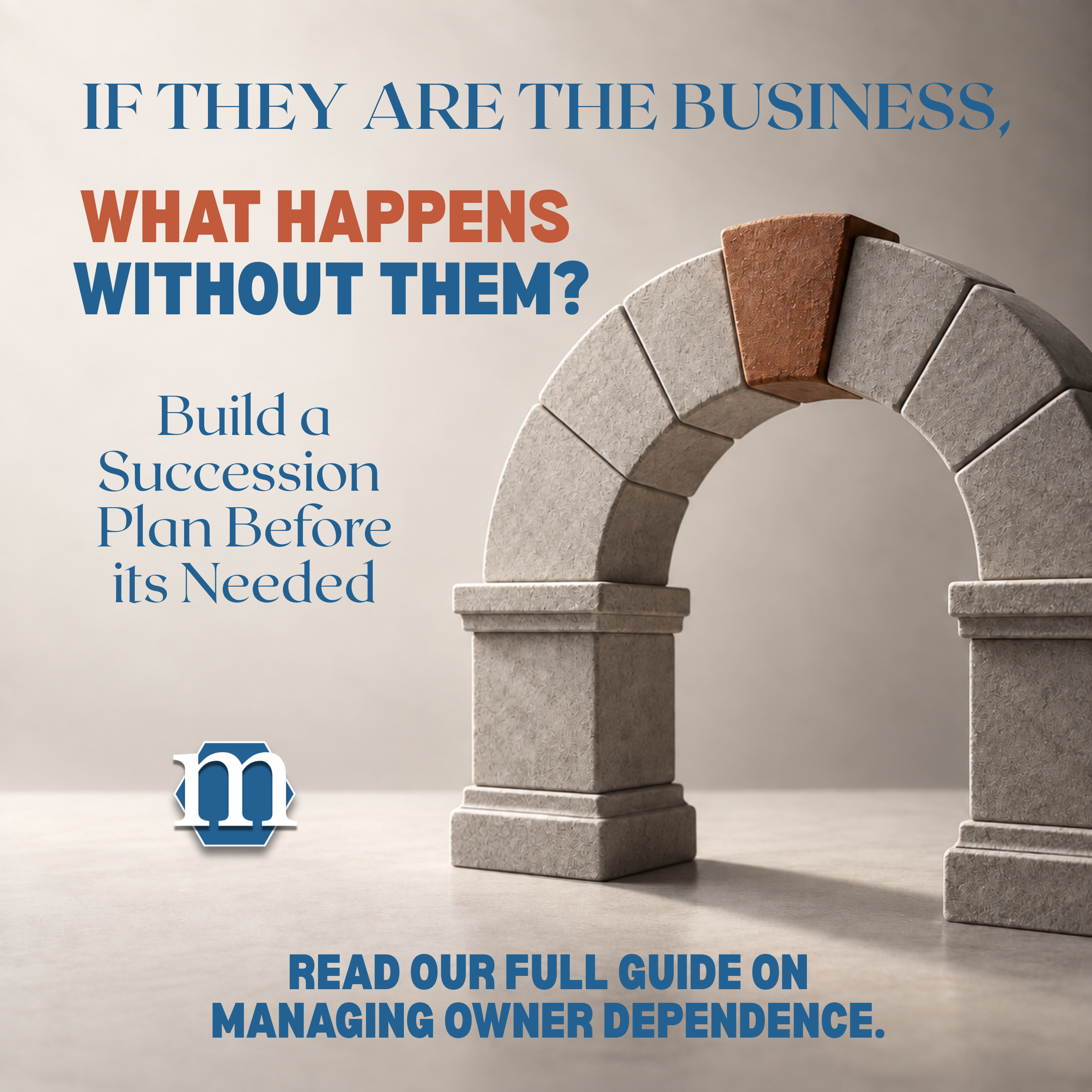 As year-end planning gets underway, business leaders are evaluating financial performance, tax strategies, benefit programs, budgets and strategic priorities for the year ahead. For owners of closely held and family businesses, that review should also include an assessment of succession and continuity risk, beginning with a fundamental question:
How dependent is the business on me?
Owner dependency exists when a meaningful portion of a company’s relationships, institutional knowledge, decision-making authority or enterprise value remains concentrated with the owner. In many privately held companies, those dependencies may have been cultivated over decades and can be difficult to separate from the individual who built the organization.
The same level of involvement that is so often integral to a company’s growth may also create significant owner dependency. In other words, risk.
If an owner retires, becomes disabled, passes away or otherwise steps away from the organization, the effects can move quickly through the business. Longstanding client relationships and employee stability may be tested, with potential consequences for revenue and, ultimately, the enterprise value the owner spent decades building.
Business succession planning can help address this exposure well before an owner’s departure becomes imminent. Determining who will eventually assume control is part of that process; reducing the company’s dependence on any one individual is the more immediate challenge.
Understanding and managing that dependency requires time. The earlier succession becomes part of the strategic planning process, the better.
Why Succession Planning Should Begin Years Before Retirement
One of the more consequential challenges in business succession planning is allowing an anticipated retirement date to initiate the process. By that point, some of the most valuable preparation time may already have passed.
An effective transfer of leadership requires more than identifying a successor and establishing a transition date.
Much of an owner’s influence within a business has been accumulated over time. Institutional knowledge and client confidence are part of it, as are the judgment and credibility developed through years of making consequential decisions. None transfers automatically with ownership.
A longer planning horizon creates space for those less tangible assets to migrate while the owner remains actively engaged. Future leaders can begin making increasingly important decisions and developing their own relationships with clients and professional advisors. Just as importantly, employees have time to begin viewing the successor as a leader in his or her own right.
This period of overlap also allows the transition to be tested while the current owner is still there to offer guidance and help make adjustments.
Where does the successor require additional development? Which decisions continue to migrate back to the current owner rather than the emerging leadership team?
Identifying those dependencies several years before an exit creates an opportunity to address them. Discovering them several months before an exit can substantially limit the available alternatives.
Leadership readiness is one consideration. The transition also has to work financially. A change in ownership can create new demands for liquidity and capital at the same time the organization may be evaluating compensation or retention arrangements for the people expected to carry the business forward. Business owners must reconcile those demands with their own financial objectives.
Key-Person Risk Extends Beyond Ownership
Concentration risk can also exist elsewhere in the organization. Key-person risk exists when the departure of an executive or employee could materially disrupt revenue, client relationships, operations or leadership continuity.
A CFO, senior revenue leader, operations executive or other key employee may control important client relationships, possess specialized capabilities or hold institutional knowledge that would be difficult and costly to replace. In some organizations, a surprisingly small group of people holds much of the knowledge, relationships and authority required to keep the business operating effectively.
Changes in ownership and leadership can introduce uncertainty for employees at precisely the point when organizational stability matters most. If key executives depart during the transition, the incoming leader may inherit not only a new role, but a diminished management team and additional operational risk.
Who can the business least afford to lose?
A continuity plan that does not account for both succession and key talent can leave an important source of organizational risk unaddressed. Executive compensation, benefit design and retention arrangements can play an important role in maintaining leadership continuity and aligning key employees with the organization’s longer-term objectives.
A successor’s name on paper provides little assurance of continuity if that individual is unprepared, the surrounding leadership team is vulnerable to turnover, or the organization lacks the financial resources to support the transition.
Family Business Succession: When Ownership and Leadership Diverge
For family-owned companies, succession can become considerably more complex because ownership, management responsibilities, family relationships and personal wealth frequently intersect.
Ownership succession and management succession are not necessarily the same decision.
A family member may be an appropriate recipient of an ownership interest without being the individual best positioned to assume executive leadership. Conversely, the strongest future leader may not be the family member expected to receive the largest economic interest in the company.
The distinction becomes even more important when some family members participate actively in the business while others do not. Transferring control to the next generation may make operational sense while creating an entirely different question about how family members outside the business participate in its value. Liquidity, governance and equitable treatment can quickly become competing considerations.
These decisions may also have implications beyond the business itself. An owner’s succession strategy may need to coordinate with personal financial objectives, estate planning and the distribution of family wealth. What appears equitable from an inheritance standpoint may not produce an effective ownership structure. Equal economic interests, for example, can have very different implications for management authority, liquidity and the capital needs of the company.
These competing objectives are considerably easier to reconcile before a transition is underway and positions have hardened.
Making Succession Part of the Year-End Conversation
Business succession planning is not simply preparation for an owner’s eventual retirement. It is an important component of owner risk management and preserving enterprise value beyond the current generation of leadership.
Rather than focusing exclusively on when an owner intends to leave the business, leadership teams should consider what would happen if the owner’s level of involvement changed sooner than anticipated.
Questions Business Owners Should Be Asking
→ Where does the business remain most dependent on the owner?
→ What would happen if the owner stepped away sooner than expected?
→ Who else would be difficult for the business to lose during a transition?
→ Is the next generation of leadership prepared to lead without the current owner?
For business owners who have spent decades building an organization around their leadership, relationships and judgment, the ultimate measure of a succession strategy is not simply whether ownership can be transferred.
It is whether the value of the business can endure after it is.
To evaluate how a succession planning framework can help strengthen your business continuity and exit strategy, schedule a complimentary consultative conversation with Bill Stoddart, VP of Financial Services at McInnes Group.
Disclosures: This material and the opinions voiced are for general information only and are not intended to provide specific advice or recommendations for any individual or entity. To determine what is appropriate for you, please contact your McInnes Financial Professional. Information obtained from third-party sources are believed to be reliable but not guaranteed. The tax and legal references attached herein are provided with the understanding that McInnes Group is not engaged in rendering tax, legal, or actuarial services. If tax, legal, or actuarial advice is required, you should consult your accountant, attorney, or actuary. McInnes Group does not replace those advisors. Securities and Investment Advisory Services Offered Through M Holdings Securities, Inc. A Registered Broker/Dealer and Investment Adviser, Member FINRA/SIPC. McInnes Group, Inc. is independently owned and operated. File# 5952821 exp. 9/2028